






.svg)

Your taxonomy is the most valuable asset in your CX stack. Do you actually own it?

Is your taxonomy truly yours?
Here's a question most CX and Product leaders have never been asked directly.
Who controls the system you use to categorise customer feedback? The taxonomy that defines what a "billing issue" is, how you distinguish "onboarding friction" from "product confusion," how you label a complaint versus a feature request? Who can change it? Who understands it well enough to improve it? And what happens to it if the person who built it leaves?
For most organisations, the honest answer is uncomfortable. The taxonomy is either locked inside a vendor's system, scattered across spreadsheets and tribal knowledge, or dependent on a single engineer who is already stretched across three other projects.
This is not a minor operational detail. The taxonomy is the lens through which your entire organisation sees customer reality. If it's wrong, outdated, or out of your control, every insight built on top of it is compromised, no matter how sophisticated your AI, how expensive your platform, or how talented your team.
Let's go through what each approach actually gives you. And what it quietly takes away.
Generic AI: the illusion of understanding
The appeal of using general-purpose AI for customer feedback analysis is real. You describe what you want, the model categorises it, and the output looks coherent. It uses language you recognise. It produces themes that feel meaningful.
The problem is that the model has no idea what your business actually is.
When you ask it to categorise "the checkout keeps crashing," it doesn't know whether that belongs under your "Technical Issues" category, your "Payment Experience" category, or a newly created "Mobile App Performance" cluster that your team created last quarter after a major release. It doesn't know that in your taxonomy, "pricing complaints" are tracked separately from "value perception" because your Head of Product specifically asked for that distinction eighteen months ago.
It doesn't know any of this, because it can't. General-purpose AI operates on language patterns, not business context. Every time you start a new session, you start from zero. There is no persistent understanding of your company, your product, your market, or your history.
And keeping the model updated on your context is a full-time job that doesn't scale. You can write better prompts. You can paste in more background. But you cannot give a stateless system the deep, structured, evolving understanding of your business that accurate taxonomy requires.
The result is categorisation that looks right but isn't because it's built on a generic model of the world rather than a precise model of yours. The insights feel actionable. The decisions built on them are shakier than they appear.
Legacy VoC platforms: renting someone else's categories
Enterprise VoC platforms solve the statefulness problem. They have persistent structures. They store your data over time. They build a picture that accumulates.
But here's the catch: they also built the picture frame, and you didn't get a vote on its dimensions.
The taxonomy in most legacy VoC platforms is vendor-defined. It reflects how the vendor thinks about customer experience — their best practices, their default categories, their view of what matters. Which might overlap with your business. And might not.
When your business evolves, when you launch a new product line, enter a new market, restructure your support categories, or change how you think about customer segments, changing the taxonomy is rarely straightforward. It typically means going back to the vendor. Opening a support ticket. Waiting for a call with your customer success manager. Possibly paying for a consulting engagement to make changes that should take an afternoon.
This is not a hypothetical. It's the standard operating model for a category of tools that was designed to be sticky, not flexible. The vendor's revenue model depends on your continued dependency, which means every layer of friction in making changes is, from their perspective, working as intended.
You end up with a taxonomy that's a compromise between what you need and what the vendor supports. You end up paying — directly or in time — every time the business changes and the taxonomy needs to follow. And over years, the gap between how your taxonomy describes your customer reality and how your customer reality actually looks quietly widens, until the data you're working from no longer reflects the business you're running.
In-house builds: ownership that walks out the door
Building your own taxonomy infrastructure is the choice that looks like the purest expression of ownership. You define the categories. You control the logic. You build exactly what your business needs.
And for a while, that's exactly what happens.
Then the person who designed it takes a new role. Or leaves the company. Or gets pulled into a higher-priority project and stops maintaining it. And what you discover (usually at the worst possible moment) is that the ownership was never really in the system. It was in the person.
The taxonomy logic lives in their head. The edge cases they handled are undocumented. The decisions they made about how to resolve ambiguous inputs were never written down because they were obvious to them at the time. The junior analyst who inherits the system can use it, but can't confidently improve it. So they don't. And it drifts.
New products don't get new categories. Emerging issues get forced into old buckets because creating new ones feels risky. The taxonomy stops evolving not because the business stopped changing, but because the person with the expertise and the authority to change it is no longer there.
This is the dependency that in-house builds create, and it's the one that's hardest to see before it bites you. It's not a dependency on a vendor. It's a dependency on an individual — which is in some ways more fragile, because individuals, unlike vendors, don't have SLAs.
What owning your taxonomy actually means
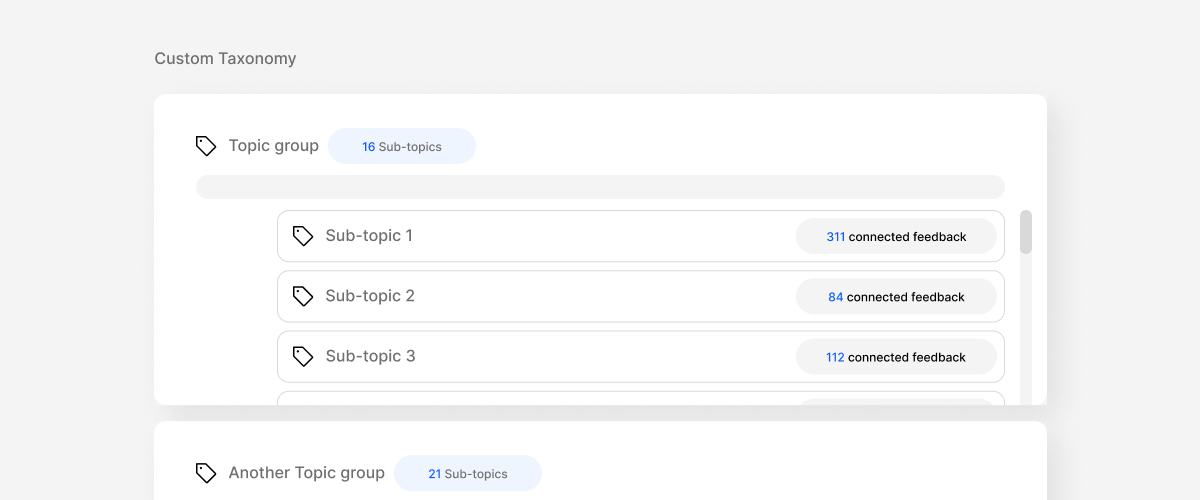
Zefi's approach starts from a different premise: the taxonomy belongs to you. Not to us. Not to the person who configured it. To your organisation.
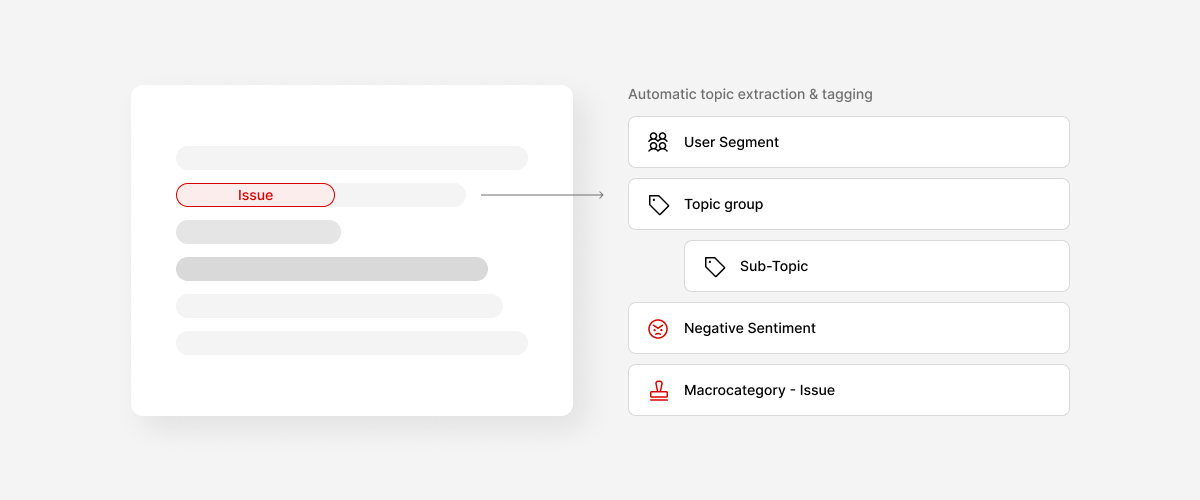
That means it's auditable. You can see exactly why a piece of feedback was categorised the way it was, trace it back to the logic that produced it, and challenge it if something looks wrong. There are no black boxes. Every categorisation decision is explainable and revisable.
It means it's versioned. When you change a category because your business evolved, because a new product launched, because a Head of CX with strong opinions joined the team, that change is recorded. You know what the taxonomy looked like six months ago. You can compare results across versions. You don't lose your history every time you improve your structure.
And it means it's yours in the most important sense: it reflects your company. Not a generic best-practice template. Not a vendor's view of what matters in your industry. A structured, precise, continuously improving model of how your organisation thinks about customer experience, built from your data, shaped by your context, guided by a team that has done this across enough businesses to know where the edge cases are.
The clustering is sharper because the model understands your world. The tagging is more accurate because it's been calibrated to the way your customers actually describe things, not the way a general language model expects them to. And when something changes (when a new issue emerges that doesn't fit existing categories), Zefi surfaces the anomaly instead of forcing it into the nearest approximation.
Why taxonomy is the thing that everything else depends on
Insights are only as good as the structure that produces them. Alerts are only as useful as the categories they monitor. Reports are only as trustworthy as the taxonomy that underlies them.
If your taxonomy is locked in a vendor's system, your insights are constrained by their vision. If it's dependent on a single person, your organisation's understanding of its customers is one resignation away from degrading. If it's built on a generic AI model with no persistent context, you're making business decisions on pattern-matching that doesn't know your business.
The teams that take taxonomy seriously (that treat it as a core asset rather than a configuration detail), are the ones that build a durable, compounding intelligence advantage. Because every good categorisation decision makes the next one easier, faster, and more accurate.
Zefi is built on that belief. The taxonomy is yours. It's auditable. It's versioned. It knows your context. And it gets sharper every week.
That's not a feature. That's the foundation.
A member of our team will get in touch soon


Extract value from user feedback
Unify and categorize all feedback automatically.
Prioritize better and build what matters.



.svg)

